Tuesday, August 27, 2024

Relative Valuation-What is P/E Ratio ?

The Price-to-Earnings (P/E) ratio is a widely used tool in stock valuation that provides insight into 

How much investors are willing to pay for each rupee of a company's earnings. 

Here’s a more detailed look at how it works and some considerations for its use:

How to Compute the P/E Ratio

  1. Historical (Trailing) P/E Ratio:

    • Formula: Trailing P/E=Current Stock PriceTrailing EPS\text{Trailing P/E} = \frac{\text{Current Stock Price}}{\text{Trailing EPS}}
    • Example: If the stock price is Rs. 100 and the EPS for the past four quarters is Rs. 5, then the trailing P/E ratio is 20 (i.e., 1005\frac{100}{5}).
  2. Forward (Leading) P/E Ratio:

    • Formula: Forward P/E=Current Stock PriceForecasted EPS\text{Forward P/E} = \frac{\text{Current Stock Price}}{\text{Forecasted EPS}}
    • Example: For a company with EPS estimates of Rs. 6 for the next four quarters and a current stock price of Rs. 100, the forward P/E ratio would be approximately 16.67 (i.e., 1006\frac{100}{6}).

Interpreting the P/E Ratio

  • P/E Ratio Insight: A P/E ratio indicates how much investors are willing to pay per rupee of earnings. For instance, a P/E of 10 means investors are willing to pay Rs. 10 for every Rs. 1 of earnings.

  • Comparison: To assess whether a stock is fairly valued:

    • Compare it to the market average P/E.
    • Compare it with the industry average P/E.
    • Compare it to the P/E ratios of peer companies.

    For example, a stock priced at Rs. 10 with a P/E of 75 is considered more expensive than a stock priced at Rs. 100 with a P/E of 20, assuming other factors are equal.

Limitations of the P/E Ratio

  1. Future Earnings Uncertainty: Forward P/E ratios rely on earnings estimates, which might not always be accurate. Economic conditions, market competition, and company-specific factors can all impact actual earnings.

  2. Negative EPS: For companies with negative earnings (negative EPS), the P/E ratio becomes meaningless or misleading. These companies often cannot be valued using traditional P/E metrics.

  3. Economic Fluctuations: The average P/E ratio can vary significantly with economic conditions. For instance, during economic downturns, P/E ratios may contract even if the earnings projections remain stable.

  4. Different Industry Standards: P/E ratios can vary widely across different industries. A high P/E in one industry might be normal, while it could be considered too high in another.

  5. Growth vs. Value: High P/E ratios are often associated with growth stocks that are expected to grow earnings rapidly, while low P/E ratios might suggest value stocks that are undervalued or struggling.

Summary

The P/E ratio is a valuable tool for assessing stock valuation but should be used in conjunction with other metrics and analysis methods. Consideration of industry norms, market conditions, and future earnings potential is essential for a more comprehensive evaluation of a stock’s worth.


P/E अनुपात की गणना और व्याख्या

P/E अनुपात (Price-to-Earnings Ratio) एक महत्वपूर्ण उपकरण है जो यह बताता है कि निवेशक एक कंपनी की प्रत्येक रुपये की आय के लिए कितना भुगतान करने को तैयार हैं। यहाँ इसका विस्तृत विवरण है:

P/E अनुपात की गणना कैसे करें

  1. इतिहासिक (Trailing) P/E अनुपात:

    • सूत्र: Trailing P/E=वर्तमान स्टॉक मूल्यTrailing EPS\text{Trailing P/E} = \frac{\text{वर्तमान स्टॉक मूल्य}}{\text{Trailing EPS}}
    • उदाहरण: यदि स्टॉक का मूल्य Rs. 100 है और पिछले चार तिमाहियों का EPS Rs. 5 है, तो trailing P/E अनुपात 20 होगा (यानी, 1005\frac{100}{5})।
  2. आगामी (Forward) P/E अनुपात:

    • सूत्र: Forward P/E=वर्तमान स्टॉक मूल्यअनुमानित EPS\text{Forward P/E} = \frac{\text{वर्तमान स्टॉक मूल्य}}{\text{अनुमानित EPS}}
    • उदाहरण: यदि अगले चार तिमाहियों के लिए EPS अनुमानित Rs. 6 है और वर्तमान स्टॉक मूल्य Rs. 100 है, तो forward P/E अनुपात लगभग 16.67 होगा (यानी, 1006\frac{100}{6})।

P/E अनुपात की व्याख्या

  • P/E अनुपात का अर्थ: P/E अनुपात बताता है कि निवेशक प्रति रुपये की आय पर कितना भुगतान करने के लिए तैयार हैं। उदाहरण के लिए, P/E अनुपात 10 का मतलब है कि निवेशक प्रत्येक Rs. 1 की आय के लिए Rs. 10 भुगतान करने को तैयार हैं।

  • तुलना: यह देखने के लिए कि स्टॉक उचित मूल्य पर है या नहीं:

    • बाजार के औसत P/E से तुलना करें।
    • उद्योग के औसत P/E से तुलना करें।
    • सहकर्मी कंपनियों के P/E अनुपात से तुलना करें।

    उदाहरण के लिए, Rs. 10 मूल्य वाले स्टॉक का P/E अनुपात 75 होता है, तो यह Rs. 100 मूल्य वाले स्टॉक के P/E अनुपात 20 से अधिक महंगा माना जाएगा, यदि अन्य कारक समान हों।

P/E अनुपात की सीमाएँ

  1. भविष्य की आय की अनिश्चितता: Forward P/E अनुपात आय के अनुमानों पर निर्भर करते हैं, जो हमेशा सटीक नहीं हो सकते। आर्थिक स्थितियाँ, बाजार की प्रतिस्पर्धा, और कंपनी-विशेष कारक वास्तविक आय को प्रभावित कर सकते हैं।

  2. ऋणात्मक EPS: जिन कंपनियों का EPS ऋणात्मक होता है, उनके लिए P/E अनुपात का उपयोग अर्थपूर्ण नहीं होता और यह भ्रामक हो सकता है। इन कंपनियों की पारंपरिक P/E मेट्रिक्स का उपयोग करके मूल्यांकन करना कठिन होता है।

  3. आर्थिक उतार-चढ़ाव: औसत P/E अनुपात आर्थिक स्थितियों के साथ भिन्न हो सकता है। उदाहरण के लिए, आर्थिक मंदी के दौरान, P/E अनुपात संकुचित हो सकते हैं, भले ही आय की भविष्यवाणियाँ स्थिर हों।

  4. उद्योग मानक: विभिन्न उद्योगों में P/E अनुपात काफी भिन्न हो सकते हैं। एक उद्योग में उच्च P/E सामान्य हो सकता है, जबकि दूसरे में इसे बहुत अधिक माना जा सकता है।

  5. वृद्धि बनाम मूल्य: उच्च P/E अनुपात अक्सर उन वृद्धि स्टॉक्स से जुड़े होते हैं जो आय में तेजी से वृद्धि की उम्मीद रखते हैं, जबकि कम P/E अनुपात मूल्य स्टॉक्स को दर्शाते हैं जो कम मूल्यांकित या संघर्ष कर रहे होते हैं।

सारांश

P/E अनुपात एक महत्वपूर्ण उपकरण है जो स्टॉक मूल्यांकन में मदद करता है, लेकिन इसे अन्य मेट्रिक्स और विश्लेषण विधियों के साथ उपयोग करना चाहिए। उद्योग मानकों, बाजार की स्थितियों, और भविष्य की आय की संभावनाओं पर विचार करना एक स्टॉक के मूल्यांकन के लिए महत्वपूर्ण है।

Monday, August 26, 2024

What is Bonus Issue ?

 A bonus issue of shares is made to the existing shareholders of a company without any consideration from them. The entitlement to the bonus shares depends upon the existing shareholding of the investors. A bonus issue int he ratio 1:3 entitles the shareholder to 1 bonus share for every 3 held. The Company makes the bonus issues out of its free reserves built from genuine profits. A company cannot make a bonus issue if it has defaulted on the payment of interest or principal on any debt securities issues or any fixed deposit raised.

A company has to get the approval of its board of directors for a bonus issue. In some cases, the shareholders of the company also need to approve the issue. Where the shareholders' approval is not required, the bonus issues must be completed withing 15 days of the board's approval. Where approval of the shareholder is required, the issue must be completed withing two months of receiving the board's approval. A bonus issue once announced cannot be withdrawn. The record date for the bonus issue will be announced and all shareholders as on the record date will be entitled to receive the bonus.


एक बोनस इश्यू तब किया जाता है जब एक कंपनी अपने मौजूदा शेयरधारकों को बिना किसी मूल्य के शेयर प्रदान करती है। बोनस शेयरों का अधिकार निवेशकों के मौजूदा शेयरधारिता पर निर्भर करता है। उदाहरण के लिए, यदि बोनस इश्यू 1:3 के अनुपात में है, तो इसका मतलब है कि हर 3 मौजूदा शेयरों के बदले में एक बोनस शेयर मिलेगा। कंपनी बोनस इश्यू अपने वास्तविक लाभों से बने फ्री रिज़र्व्स से करती है। यदि कंपनी ने किसी भी ऋण सुरक्षा या किसी निश्चित जमा पर ब्याज या मूलधन के भुगतान में चूक की है, तो वह बोनस इश्यू नहीं कर सकती।

कंपनी को बोनस इश्यू के लिए अपने बोर्ड ऑफ डायरेक्टर्स की मंजूरी प्राप्त करनी होती है। कुछ मामलों में, कंपनी के शेयरधारकों की भी मंजूरी आवश्यक होती है। जहां शेयरधारकों की मंजूरी की आवश्यकता नहीं होती, वहां बोनस इश्यू को बोर्ड की मंजूरी के 15 दिनों के भीतर पूरा किया जाना चाहिए। जहां शेयरधारकों की मंजूरी आवश्यक होती है, वहां इश्यू को बोर्ड की मंजूरी प्राप्त करने के दो महीनों के भीतर पूरा किया जाना चाहिए। एक बार बोनस इश्यू की घोषणा के बाद इसे वापस नहीं लिया जा सकता। बोनस इश्यू के लिए रिकॉर्ड तिथि की घोषणा की जाएगी और रिकॉर्ड तिथि पर सभी शेयरधारकों को बोनस प्राप्त होगा।

What is Right Issue?

 RIGHT ISSUE

Whenever a company makes a fresh issue of shares, it has an impact on the existing shareholders since their proportionate holding in the share capital of the company gets diluted. For example, a company may have 10 lakh shares of Rs. 10 each, amounting to an issue and paid-up capital of Rs. 1 Crore. If it issues another 10 Lakh shares, to increase its capital, the proportion held by existing shareholders will come down by half, as the issues and paid-up capital has doubled. This is called as dilution of holdings. To prevent this the Company's Act required that a company which wants to raise more capital through an issue of shares must first offer them to the existing shareholders. Such an offer of shares is called a right issue.

The rights shares are offered to the existing investors in a proportion as approved by the board of a company. For example, the company may choose to issue rights at 1 for 1, to double its capital. This means each existing shareholder will get one equity share for every one equity share that they already hold. The issues and paid capital will double, but proportionate holdings will not change, Ratio of rights issues need not always be one. They can 1:2, 2:3 and 2:5 and so on, depending on the decision of the board of the company. A right issue of share must follow all the SEBI's regulations on issues of shares. A listed company making a rights issue shall fix a record date to determine the eligibility of the shareholders for the right issue. The company must issue a letter of offer giving details of the issue including the purpose for which funds are being raised. The draft letter of offer must be filed with SEBI. The rights entitlement are credited to the demat account of the investor.


राइट इश्यू

जब कोई कंपनी नई शेयरों का इश्यू करती है, तो इसका असर मौजूदा शेयरधारकों पर पड़ता है क्योंकि उनके शेयर पूंजी में हिस्से का अनुपात घट जाता है। उदाहरण के लिए, एक कंपनी के पास 10 लाख शेयर हैं, जिनका मूल्य 10 रुपये प्रति शेयर है, जिससे कुल जारी और चुकता पूंजी 1 करोड़ रुपये है। यदि कंपनी 10 लाख और शेयर जारी करती है, ताकि अपनी पूंजी बढ़ा सके, तो मौजूदा शेयरधारकों का अनुपात आधे में आ जाएगा, क्योंकि जारी और चुकता पूंजी डबल हो गई है। इसे हिस्सेदारी का पतला होना कहते हैं। इसे रोकने के लिए कंपनी अधिनियम की आवश्यकता है कि जो कंपनी शेयर जारी कर के अधिक पूंजी जुटाना चाहती है, उसे पहले मौजूदा शेयरधारकों को प्रस्ताव देना चाहिए। ऐसे शेयरों के प्रस्ताव को "राइट इश्यू" कहा जाता है।

राइट्स शेयर मौजूदा निवेशकों को बोर्ड द्वारा अनुमोदित अनुपात में पेश किए जाते हैं। उदाहरण के लिए, कंपनी 1:1 के अनुपात में राइट्स इश्यू कर सकती है, जिससे उसकी पूंजी डबल हो जाएगी। इसका मतलब है कि प्रत्येक मौजूदा शेयरधारक को हर एक शेयर के बदले में एक अतिरिक्त शेयर मिलेगा जो वे पहले से ही रखते हैं। जारी और चुकता पूंजी डबल हो जाएगी, लेकिन अनुपातित हिस्सेदारी में कोई बदलाव नहीं होगा। राइट्स इश्यू का अनुपात हमेशा 1:1 नहीं हो सकता। यह 1:2, 2:3 और 2:5 आदि हो सकता है, जो कंपनी के बोर्ड के निर्णय पर निर्भर करता है। एक राइट इश्यू को SEBI के शेयर इश्यू पर सभी नियमों का पालन करना चाहिए। एक सूचीबद्ध कंपनी जो राइट्स इश्यू करती है, उसे शेयरधारकों की पात्रता निर्धारित करने के लिए एक रिकॉर्ड तिथि तय करनी चाहिए। कंपनी को एक प्रस्ताव पत्र जारी करना चाहिए जिसमें इश्यू का विवरण और पूंजी जुटाने के उद्देश्य को शामिल किया जाना चाहिए। प्रस्ताव पत्र का ड्राफ्ट SEBI के साथ जमा किया जाना चाहिए। राइट्स एंटाइटलमेंट निवेशक के डिमैट अकाउंट में क्रेडिट किए जाते हैं।


Sunday, August 25, 2024

The Indian Financial Markets-Introduction

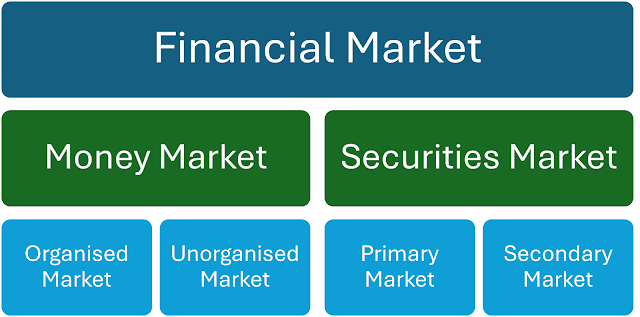
The financial markets enable efficient transfer and allocation of resources for productive activities in the economy. Users of funds include governments, businesses and households who seek funds to run their activities. Governments, businesses and households also act as providers of surplus funds. Intermediaries such as banks, financial institutions, mutual funds and insurance companies, among others, channelize the available surplus funds from lender to the users.


The function of the financial markets is to ensure that economic activity is enables by providing access of funds to those that need it for consumption or productive activity. They provide a way for aggregation of funds from a large number of investors and make it available for productive economic activity, For Example, Banks collect deposits from a large number of depositors who have surplus funds and lend it to individuals and businesses who seek loans to meet their need for funds. In the absence of financial markets such aggregation may not be possible. 

An efficient financial market ensures that the transfer of funds happen at a cost that makes it attractive for savers to save and lend and for users to borrow funds. The markets must enable the dissemination of relevant information to all its participation so that decision is made after integrating all available information that determine the risk and return for the lenders and cost of funds to the borrowers. It must also allow the participants to review their funding decisions given new information and to reallocate the resources accordingly.

Therefore, providing liquidity and exit options are an important function of financial markets. Financial market regulation and regulators focus of setting up system and processes in place to streamline the activities associated with the transfer of funds.

Thursday, August 31, 2023

TRADING-How to increase usability of trading style-Part 3 -"Pattern Confirmation"

So how do we confirm a pattern? There are several methods and it is down to personal preference as to how you decide to confirm your patterns. However please be warned that the word ‘confirmation’ can be a little misleading as just because we confirm a pattern it does not guarantee that the pattern will be fulfilled. Confirmation simply means ‘a point on the chart in which we assume, when crossed, the pattern may reach a target’.
 
A pattern can be confirmed, only to see price reverse and trade back into the suspected pattern to make it a ‘failed pattern’. Each pattern has a breakout line which is similar to drawing a trendline or S/R level.    
Uploading: 62690 of 62690 bytes uploaded.

Breakout: We simply require price to cross the line. This is an ideal method if you want to set pending orders to catch the breakout. However price can (and does) return back over the breakout line to invalidate the pattern.

Close: We want to see price close a bar over the line to confirm the signal. This provides extra confidence and reduces the chances of it being a failed signal, however you also risk missing the move and for price to take off without you.


Multiple Closes: Some analysts use 2 or 3 closes to confirm the pattern. Whilst this provides even greater confidence you again risk the chance of missing the move for it to be profitable enough (for your reward/risk ratio)


Throwback: A throwback is my preferred style if trading the pattern. This is where price breakouts out or closes to confirm the pattern, but then returns to the breakout line. If this level then holds as either support or resistance it can provide an excellent entry with greater confidence and precision to achieve a much better reward/risk ratio. However the downside to this approach is you are much more likely to repeatedly miss moves if it doesn’t quite return to the breakout line.


I would not say that one method is not particularly better than the other, but it is important to use a method which suits your trading style and personality. For example an aggressive day-­‐trader who must be in the markets as much as possible may not have the patience to wait for a throwback (in fear of missing out) so a breakout approach may be better. Similarly and End of Day trader with more patience may be better suited to the throwback.

Sunday, August 20, 2023

Two Levels of Wealth

 Two Levels of Wealth


Financial freedom is when you have enough money to do whatever you wish to do, work wherever you wish to work, and live the way you wish to live.


This is achieved by the time you are able to create a corpus somewhere between Rs. 5 Crs to Rs. 8 Crs.


This essentially means that a person who is having Rs 8 cr. Is as wealthy as a person having Rs  800 cr. Of even more at a Personal Level.


This is a very important point to bear in mind.


So why do people want more wealth even after crossing this level.


That is because people don't know about the power of compounding.


Why want more when it is not going to serve you, and that's a guarantee.


Is there a real reason to want more? 


Yes, there is one, and this is called the Social Financial Freedom.


This is having the freedom to change the lives of others. 


This is having the freedom to manufacture employment.


This is having the freedom to make the lives of people better.


And we are here talking about people who we don't even know.


This freedom is about progressing the society, the state, the nation, and the world.


This is the freedom to meditate, to love, to be content with yourself.


Sitting in a room alone for 30 mins and feeling completely in peace is the Social Financial Freedom.


This is the point of Beyond A Milion Dollars or Rs 8cr. is the inflection point after which we need to live for a Purpose for a Massive Vision. 


Not realising this and mindlessly building wealth will lead to a life of abundant poverty - abundant money + abundant unhappiness.


Time has come to discover the two levels of financial freedom, Personal Financial Freedom & Social Financial Freedom.


- Dharmendra Satapathy


Mutual Fund Investments are subject to market risk. 


Consult Your Financial Advisor (Wealth Doctor) before Investing & Regularly for Portfolio Check-up...

Seven reasons why India is a bullish investment opportunity for the next decade

Seven reasons why India is a bullish investment opportunity for the next decade


In a world of uncertainty, where the global economic landscape is evolving rapidly India shines as a beacon of stability and growth. With its sheer size of market, robust technological strengths, impressive GDP growth, large middle class, surging consumerism and stable government, India presents a compelling case for investors looking to capitalise on long-term growth prospects.


Market Size

India boasts a population of over 1.4 billion, making it the most populous country in the world. This sheer size translates into an expansive consumer base and an attractive market for various industries. The demographic dividend – a young population – further adds to India's growth potential. With a median age of around 29 years, India is set to enjoy a substantial workforce, fostering innovation and driving economic growth.


Technological Strengths

India's prowess in the technology sector is undeniable. The country has emerged as a global technology hub, with an ever growing software industry. That, along with the exponential growth of Indian startups across sectors showcases the entrepreneurial spirit that is spreading its roots not only in large cities, but also across smaller cities. In fact, with over 50,000 startups, India's startup ecosystem is the third-largest  in the world attracting billions of dollars of FDI every year. Startups are thriving across the country, leveraging technology to address unique problems and create disruptive solutions.


GDP Growth

India's GDP growth has been consistent and robust over the years. Despite global economic fluctuations, the Indian economy has demonstrated resilience, maintaining an average growth rate of around 7 percent. This sustained growth trajectory is projected to continue, driven by domestic consumption, investment, and a growing technology sector. According to projections, India is expected to become the third-largest economy by 2027, with a GDP surpassing $5 trillion.


Rising Middle Class

The burgeoning middle class in India is a compelling driver of economic growth. As millions transition from low-income to middle-income households, their consumption patterns are transforming the country's economy. The per capita income of India is set to double from the current $2,000 to $4,000 in 2028. By 2030, it is estimated that India's middle class will number over 700 million people. This demographic shift translates to increased purchasing power, greater consumption, and heightened demand for quality products, brands and services across various industries.


Growing Defence Budget

With global geopolitical dynamics evolving, India has been steadily increasing its defence budget to modernise its armed forces with an aim to become self-reliant in defence manufacturing.  India is among the top five largest military spenders globally and by 2025, India's defence budget is projected to exceed $70 billion. This growing budget not only supports the country's defence needs but also provides opportunities for investment in defence technology and innovation.


Make in India

Since its launch in 2014, India's "Make in India" initiative has catalysed diverse sectors. Global car manufacturers like Hyundai and Suzuki have ramped up the production units thereby increasing India's automotive output. Companies like Samsung and Apple have set up local manufacturing for their mobile phone business hence reducing the dependence on imports significantly. Various other industries such as pharma, renewable energy and defence have seen significant gains due to the local manufacturing push. In the last nine years, over $100 billion of FDI has come in, in the manufacturing sector. Manufacturing will be one of the largest job creating sectors in the years to come.

Make In India-Theme Stock


Stable Government

Political stability is a cornerstone of economic growth. India's democratic setup and relatively stable governance provide a conducive environment for foreign investments and domestic economic development. Recent economic reforms, such as “Digital India” and the "Make in India" initiative, showcase the government's commitment to streamlining business operations and attracting investment. India's push for infrastructure development is a pivotal factor in its bullish outlook. The expansion of transportation networks – road, air and rail, across the country is not only fostering economic growth but also improving the quality of life for citizens.


As we traverse the next decade, India's progress promises a host of opportunities for investors and businesses seeking to be part of a dynamic growth story.  In a world where economic powerhouses are shifting, India's role is poised to become increasingly significant. As we navigate the uncertainties of the global landscape, embracing a bullish perspective on India is not just a rational choice; it is an acknowledgment of the remarkable strides the nation has already taken and the immense promise it holds for the years ahead.

Candle Matcher

Candlestick Pattern Identifier Chart par bane pattern par click karein aur uski trading strategy janein All ...